Was On A Saturday In Toronto*
Written 11-05-2025
Introduction
I hate the Chicago Cubs. Perhaps a weird start about a blog post talking about the 2025 World Series, but something that irks me when walking through Chicago is seeing the occasional shirt that looks like this:
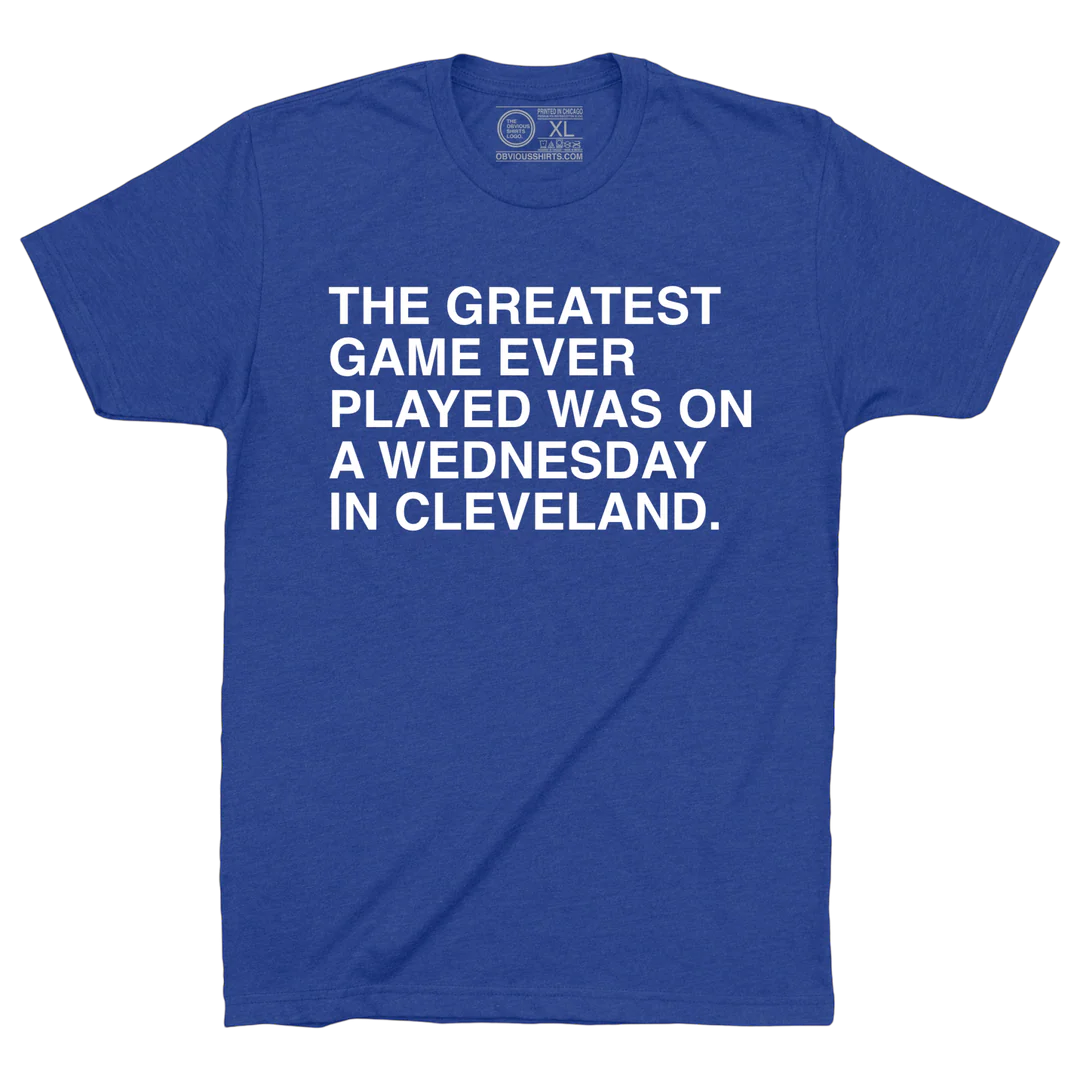
Image pulled from Obvious Shirts.
I'm not exaggerating when I say that I see one of these at least once a week. They serve as a reminder that the Cubs were the victors of an admittedly very good game of baseball with incredible implications: Game 7 of the World Series in 2016. A team that hadn't won in over a century versus a team that hadn't won in 68 years (and is approaching eighty without a win currently), in the throes of an extra-innings battle. A World Series Game 7 had only gone into extras three times before this and so much was on the line for both teams and sports cities. The Cubs ultimately prevailed, and thus the shirt and insufferable talking point was born.
I've always found the shirt and the attitude that Cubs fans hold regarding Game 7 of the 2016 World Series reductive and dismissive of other great games in baseball history. I understand that this is their franchise's great game, and every franchise has a small set of games that can be considered their greatest, but in talking to fans across the league I've found that there is no fanbase that quite digs their heels into their peak game being the "greatest" of them all quite like Cubs fans. In 2016, I was a teenager and old enough to fully comprehend what was happening in the Chicagoland area -- people that hadn't seen a baseball game in their lives were suddenly tuning into the NLCS, then the first few games of the World Series. I was in my high school dorm at the time and distinctly remember the sports-averse math and science students I lived with keeping an eye on the series, wearing blue, buying Cubs merchandise, and hosting watch parties for Game 7. The RA within my dorm, who was a known pest in terms of rule enforcement, busted some of these watch parties that were hosted by first-years who had an in-room curfew at 11pm that they were breaking. People were excited. Something that hadn't happened since the last two sightings of Halley's Comet was on the precipice of happening. Then, when the stakes were highest, the game went into extras which made the win all the sweeter.
This is all to say I understand where Cubs fans come from when they say that this game was the greatest ever played and the series was the best World Series ever. "Objectively," they say, without divorcing themselves from their bias given their team won, "this is the best World Series ever played, and we won't see a better one in our lifetimes." The World Series is as impactful of a baseball series as you can get, after all, and this one had seven games packed with unlikely heroes and enough drama to spawn multiple documentaries. Maybe we won't see a better one, after all.
What Makes a Great Game?
From what I've gathered from watching sports with others, people like dramatics, people like memorable moments, and people like high stakes. And I agree with them -- this is the core of what I personally think makes a game, regardless of the sport, great. Sports are, among many other things, a form of entertainment that allows us to root for people pushing the human limit in their field or game of choice. I have two examples to attempt to prove my point:
- A high school track meet where a runner, after falling behind early, catches up to the race leader and barely wins.
- The 2016 Olympic Men's 100 meter, where Usain Bolt beat 2nd place Justin Gatlin (.08 seconds) by more time than Gatlin beat 6th place Ben Youssef Meïté (.07 seconds).
The high school track meet had dramatics, and the Olympic race had high stakes. Each of these has part of what makes an event great -- however, the high school track meet lacked the gravitas of the Olympic event (even though, locally, it may have had high stakes) and the Olympic race lacked the dramatics of the high school event due to the inevitability of Usain Bolt (even though the best runners in the world still made for ann entertaining event). Compare these both to the final of the 2009 World Championships in Athletics, where Bolt set the world record 100 meter with a time of 9.58 and the 2nd place finisher, Tyson Gay, set a national record for the US at the time with a time of 9.71 which was, at the time, the third-fastest ever run. The drama of records being smashed and stakes of the world stage makes this considered to be one of the greatest 100-meter races ever run. The combination of stakes and dramatics is what makes a game great within the annals of baseball history, as well.
With the advent of predictive analytics in sports, something that has taken off in recent years is win probability. That is, given a state of a game, how likely is it that each team wins? This is often expressed in the form of a graph, with the x axis being time and the y axis being the probability that a team wins, capped at 100% and centered around 50%. Baseball has linear progression: teams have 27 outs split across 9 innings and attempt to earn them via plate appearances that happen one at a time. These plate appearances can result in the bases being in one of 8 states, and the team with the most runs once the outs are gone wins. Given the state of the bases, number of outs left in the game, and runs scored for each team, a win probability can be generated by using past results (i.e. "from this point, X% of teams win").
It's entertaining to see teams toss a lead back and forth, especially late in the game, and the dramatics can be quantitatively measured via the win probability graph. It's also entertaining to see a team come back from a low win probability to a coinflip (or better, winning outright and completing the comeback). We can take aspects of the win probability graph, such as how many times it changes direction and how late it changes direction, to get a general idea of how dramatic a game was. Combine that with the stakes and memorability of a game, and you get a rough measure of "greatness".
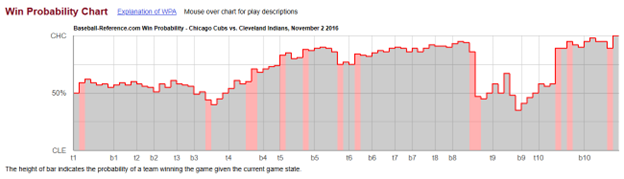
The Win Probability graph from Game 7 of the 2016 World Series. Click the image to go to the game's Baseball Reference page.
Game 7 of the World Series is as tense as it gets, stakes-wise. In Game 7, the Cubs had an early lead and as high as a 95% chance to put the game away in the 8th. However, the famous Rajai Davis home run evened things up in the bottom of the eighth, swinging the win probability by as much as 40% by the end of the inning. This chart changes direction 14 times from the top of the eighth to the end of the game, including passing the 50% mark six times, with a few distinct drops and rises. These drops and rises can be measured via Win Probability Added -- the impact players make to this chart on each play they make, both positive and negative. This stat has a sibling called Championship Win Probability Added, which measures against the probability a team wins the World Series instead of just the game. However, in the do-or-die Game 7 of the World Series, these things are one in the same, which means that in these high-stakes games players have a more direct impact on their championship odds than any other game in the season. This game has two of the top 20 plays by cWPA since 1903: the Rajai Davis home run (6th), and the Ben Zobrist double in the top of the tenth inning (20th). It also had no shortage of memorable moments: plenty of broken bats, comebacks from 5-1 and 6-3 for Cleveland, relief catcher David Ross losing balance from a wild pitch in the fifth, the rain delay that let the tension simmer heading into extras, and the jubilation when the Cubs broke their century-long curse. By all metrics, Game 7 of the 2016 World Series was a great game.
What Makes a Greater Game?
Now, let me introduce my candidate for the game that beats this one in terms of both stakes and dramatics: Game 7 of the 2025 World Series. While neither of the teams are particularly cursed, especially not to the level the Cubs or Guardians were up to 2016, this game had a few storylines feeding into it that helped up the dramatics. There was a battle of countries – the US versus Canada, which has only happened three times in World Series history – a David vs. Goliath storyline of the Blue Jays standing up against the Dodgers' gargantuan payroll and gravity that pulled great players such as Tyler Glasnow and Freddie Freeman from other teams, and Blue Jays bench coach Don Mattingly facing the team he used to manage.
The game started with Bo Bichette, who was playing injured, unable to run, and sat out the entire playoffs up to the World Series, blasting a three-run homer to give the Blue Jays a 3-0 lead in the third. Like the Cubs in 2016, they would extend this lead and hold it for the majority of the game until Miguel Rojas, who had hit one home run since mid-July, countered with a home run of his own to tie the game at 4 apiece in the top of the ninth. This lead would hold into extra innings, marking the fifth time Game 7 of the World Series has ever gone into the tenth. Unlike 2016, the tie wouldn't be broken in the tenth, marking the third time Game 7 of the World Series has ever gone into the eleventh. The Dodgers' Will Smith put a ball from Shane Bieber into Bel-Air to give the Dodgers a 5-4 lead that they would not relinquish thanks to an Alejandro Kirk ground into double play on a shattered bat -- leaving the World Series MVP in an alternate universe where the Jays won, Vladimir Guerrero Jr., on third as the home crowd was stunned at the Dodger's improbable comeback.
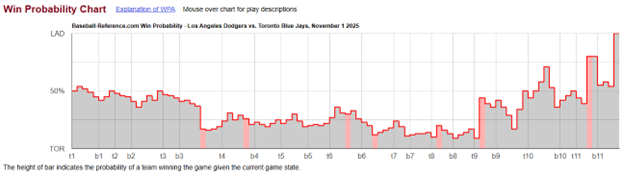
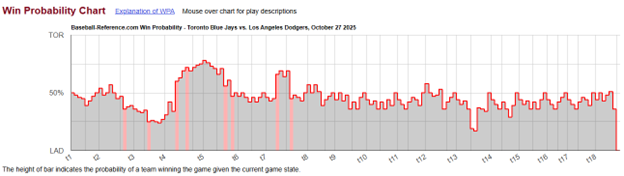
The Win Probability graph from Game 7 of the 2025 World Series. Click the image to go to the game's Baseball Reference page.
The win probability chart for this game changes directions 19 times from the top of the eighth to the end of the game, four more times than 2016, including seven passings of the 50% mark. Whereas 2016 had two of the top 20 plays by cWPA since 1903, this game had two of the top five since 1903 -- the aforementioned Will Smith homer (5th) and Alejandro Kirk ground into double play (4th). In terms of the top 20, this game also has the Rojas homer (12th) on the list. The grounder also represents the biggest swing in cWPA that negatively impacted the hitting team in MLB history. We have to go down to 17th on the list, another ground into double play ball in the 1924 World Series between the old Washington Nationals and New York baseball Giants, to find the next biggest negative impact to a hitting team. 2016 had a team staving off a comeback with the Cubs leading early and securing a win, while 2025 had a team completing a comeback with the Dodgers behind early but snatching victory from the jaws of defeat. It fully looked like this game was heading into the 12th inning with Guerrero on third with one out, as well. When I saw the final out, I thought for a second that we were heading to the twelfth for what would have been the second time in Game 7 history (the first being that 1924 World Series).
There was no shortage of memorable moments in this Game 7, either. The Rajai Davis team-saving home run from 2016 seems to have been matched by Rojas' ninth-inning prayer. Rojas hitting that home run and then making a momentum-defying throw to home plate to strike down the run that would have won the Jays the series by inches. The Jays escaping a jam in the fourth with consecutive web gems. The benches clearing in the bottom of the fourth after a throw in and hit by pitch on consecutive pitches. Blue Jays' Ernie Clement becoming the person with the most hits in postseason history, with 30 accompanying a 13-game hit streak. The actual World Series MVP, pitcher Yoshinobu Yamamoto, descending onto the mound in relief after pitching in both the previous day's Game 6 and pitching a complete game in Game 2 and not giving up a single run in 2.2 innings. A 41-year-old Max Scherzer starting this game and allowing one run in 4.1 innings of work. And, of course, the elation that comes with winning the series: Yamamoto looking up to the heavens and being raised and embraced by his catcher. It all culminated into a great baseball game and one that I consider greater than the Cubs' win in 2016.
Am I biased? Absolutely. The first sentence of this post is "I hate the Chicago Cubs", and the World Series just ended less than a week ago. I leave it to you to decide which game is greater. Either that, or bask in the greatness of both games without comparison.
What Did We Just See?
I'm done talking about the Cubs now -- writing just over 2000 words because I get angry at a t-shirt every so often is a bit much, even for me. The World Series ended on November 1st, and just under a week later I still find myself thinking how absurd the series was as a whole. To summarize each game that isn't Game 7, with the Baseball Reference page for each linked:
Game 1 was a statement win in Toronto, 4-11, after a 9-run explosion in the bottom of the sixth by the Jays. Rookie sensation Trey Yesavage started Game 1 of the World Series as a 22-year-old. Shohei Ohtani hit a huge home run in the seventh to cut the lead from 3-11 to 4-11, Chris Paul style.
Game 2 saw the Dodgers even the series up with a 5-1 win. As I mentioned earlier, Yoshinobu Yamamoto pitched a complete game. I was at a wedding during this game and watching it on a stranger's phone between songs, whose name I didn't get since we were too busy staring in awe. This is the 422nd complete game in World Series history, but the first since Johnny Cueto's in 2015 and the sixth this century. Absolute domination by the eventual World Series MVP.
Game 3 was an instant classic, and a better game than Game 7 in terms of dramatics. This game went eighteen innings, meaning that there were two games of baseball within this single game of baseball which ties the longest World Series game in history. This game would have ended in nine if a baserunning gaff with Bo Bichette and Daulton Varsho didn't happen off of a controversial missed ball call. The pitching win went to the Dodgers' Will Klein, who saved his fellow pitchers' arms by pitching 4 innings of 1-hit ball between the 15th and 18th. There were a total of 19 people that threw pitches in this game. The Dodgers put a retiring Clayton Kershaw in a bases-loaded jam in the top of the 12th and Kershaw, a known playoff choker, got out of it with a groundout. Shohei Ohtani was intentionally walked four times in this game and finished going 4-4 with 3 RBI and two home runs. The last time four intentional bases on balls happened in any baseball game was Barry Bonds in 2004. The Win Probability chart for this game changes directions 55 times from the bottom of the eighth to the end of the game and looks like a city skyline. I passed out in the bottom of the 8th and woke up in the top of the 14th and then rewatched the game the next day.
The Win Probability graph from Game 3 of the 2025 World Series.
Game 4 was a far calmer game than Game 3, with the Blue Jays taking advantage of a Dodgers’ pitching disasterclass in the top of the seventh to blow the game open from 2-1 to 6-1 before securing the win by a score of 6-2.
Game 5 blew up nearly immediately, with Blue Jays Davis Schneider and Vladimir Guerrero Jr. homering on the first and third pitch of the game on solo shots off of Blake Snell -- the first time back-to-back leadoff home runs have happened in World Series history. Trey Yesavage struck out 12 Dodgers in 7 innings of work to set a rookie World Series record, and the first pitcher period to do so in the World Series without issuing a walk. The Blue Jays put themselves one game away from winning the World Series.
Game 6 was fully scoreless except for the third inning, where the Dodgers had 3 and the Blue Jays had 1. After a huge hit in the bottom of the ninth, the ball got stuck in the wall of Rogers Centre -- a hilariously physically unlikely outcome given the construction of the warning track and stadium wall. On Halloween! Spooky! Dodgers left fielder Kike Hernandez made a wise adjustment and played in on the final pitch of the game to secure a game-ending double play. Tyler Glasnow, a career starter, earned his first career save (and also the first save of the entire series).
This series may as well be the greatest series I've watched and paid close attention to in any sport, period -- I feel like it had everything that makes baseball such a rewarding sport to watch and study: storylines, dramatics, records broken, good and bad hitting, good and bad pitching, and athletes pushing themselves to their limits. Despite Yamamoto's UCL and Bo Bichette's knees surely turning to dust, they persevered through what was essentially an eight-game series. Vladimir Guerrero OPSed at a clip of 1.289, which is the 4th best in MLB history for players with at least 20 plate appearances on a team that has made it to the World Series behind Barry Bonds in 2002 (1.559), fellow Blue Jay Paul Molitor in their 1993 winning season (1.378), and Álex Rodríguez in 2009 (1.308). Shohei Ohtani OPSed 1.096, making him 30th in this statistic (and did I mention he also pitches?). The 74 total innings of baseball played in this series is the most in MLB history since the World Series became a best-of-7 and will be tough to beat given the series that does upend it will need to go the distance and have at least twelve extra innings.
I feel very fortunate to have been able to watch this series as it unfolded and can only hope that I can one day see something as exciting as it again. I can also be happy knowing those stupid t-shirts I see around are, "objectively", wrong.