
The Milwaukee Brewers Are Evil Sorcerers
Written 01-18-2026
Introduction
I am 26 years old. I've seen the White Sox win a World Series in my lifetime, and the 2005 playoffs have a cherished place in my heart. However, outside of this blip of success and an exciting but ultimately disappointing ALDS loss to the Astros in 2021, the White Sox have not been a good baseball franchise. Since I've seriously started watching baseball in 2020, the Sox have precipitously declined from as high as sixth in the league to near last in terms of total payroll according to SpoTrac. The product on the field reflects this -- in the same span of 2020 to now, the Sox have 371 wins in 870 games, which puts them 26th out of 30 teams. The Sox are the lowest-rated team on this list that have made the playoffs in 2021 or later with the next team, the Royals, having 389 wins. The Sox' infamous 41-121 season, that is by some metrics the worst in MLB history, is the only season in the 162-game era that has fewer wins than the 2020 COVID Dodgers who had 43 in less than half the games. Beloved pitchers from the 2021 season such as Dylan Cease, Lance Lynn, and Carlos Rodón dispersed and flourished on new teams. In recent years, the White Sox debuted Garrett Crochet to much fanfare just to immediately trade him to the Red Sox in the offseason -- where he was the runner-up for this year's AL Cy Young award. Over the course of the past few years, the White Sox have been in a tremendous free fall towards the depths of baseball ineptitude. At the beginning of it all, when hope within the walls of Rate Field was directed towards playoff runs instead of hitting 60 wins in a season, a promising draft prospect by the name of Andrew Vaughn made his MLB debut.
A Golden Spikes award winner in 2018, Vaughn was selected third overall by the Sox in the 2019 draft and tore through the minor leagues. There were qualities to be excited about: scouting reports praised his hitting ability, calm plate approach, and bat speed and strength. MLB's official scouting report for Vaughn from 2020 projected him "to bat .300 with 30 homers and 80 walks on an annual basis". Vaughn showed hope and promise of an offensive injection on a team vying for the AL Central crown. In the pros in 2021, Vaughn's 162-game pace was a .235 average with 12 homers and 32 walks that coalesced into a 91 OPS+, a stat where 100 is average and adjusted by era and park -- not the projection, but excusable for a rookie digging his cleats into the highest level of professional baseball. His 2022 showed flashes of on-plate brilliance such as a 4-for-4 performance with a home run in a close 8-7 win versus the Blue Jays in mid-June or 4-for-5 and 2 RBI in a mid-September drubbing of the Athletics, 10-2. However, his defense dragged him down to a negative-WAR season despite a 111 OPS+, which would wind up being his best offensive mark in the ensuing three years. Vaughn on the White Sox failed to live up to his billing as a top prospect making millions of dollars, as he was a below-replacement player by Wins Above Replacement (-0.5) and posted a 97 OPS+ with the White Sox from his debut to 2025.
WAR is not always a reliable narrator, but it is widely accepted to be a somewhat-accurate indicator of player value and can provide insights into which parts of a player's repertoire contribute to team success. Vaughn's oWAR, or offensive WAR, was 3.0 in his time with the White Sox while his dWAR, or defensive WAR, sat at -6.7. Vaughn's -6.7 is the worst mark of anyone don the White Sox' jersey from 2021 to 2025, with the next closest being Gavin Sheets' -5.0. The calm batsman with a sturdy presence at first base in college (only allowing 2 errors in his Golden Spikes-winning 2018 season, where he also earned Pac 12 All-Defensive honors) went cold offensively and collapsed defensively for the White Sox. As a fan, I was prepared for something bad to happen every time Vaughn went up to bat or a ball was headed towards first base. In 2025, Andrew Vaughn ran into the roughest streak of his career: an ugly .189/.218/.314 slashline over 48 games resulting in a 47 OPS+ and -1.4 oWAR for his first negative season in this statistic. This, coupled with the anemic defense that plagued his entire career up to this point, caused the White Sox to demote Vaughn to the minor leagues where neither facet of his game improved. Over 15 games in AAA, Vaughn slashed .211/.328/.351, a far cry from even his 2024 season in the majors where he put up .246/.297/.402.
This is a scathing indictment of just Andrew Vaughn, which is unfair given the team's malignant ownership and rancid atmosphere as the Sox moved from playoff hopeful to racing the 1962 New York Metropolitans to the bottom. However, Vaughn -- often starting games and batting below the Mendoza line -- made for an easy scapegoat. As seen by the title of this article, Vaughn did not finish his career as a White Sock. In a move that was puzzling at the time, the surging Milwaukee Brewers bought Andrew Vaughn and his contract from the Sox for disgruntled pitcher Aaron Civale. Hannah Filippo reporting for the South Side Sox, an SB Nation White Sox-based community, called the parting a "not-so-bitter but oh-so-sweet ending to the Vaughn saga". I personally was content that Vaughn was off the Sox and a gap in the White Sox' pitching rotation was filled. To spoil the story, Vaughn went on to have a historic turn-around wearing Brewers yellow, while Civale was waived by the Sox and picked up by the Cubs within a few months. The Andrew Vaughn story, however, is far more interesting than this.
The Resurgence
The most effective way to look at Andrew Vaughn's 2025 season in summary, in my opinion, lies on his Baseball Reference page. Below a few disappointing White Sox seasons, his stats for 2025 are split by team: 48 games for the White Sox, and 64 games for the Brewers.

Andrew Vaughn's baseball reference summary table for 2025.
I'm aware that Baseball Reference is a place with an overwhelming amount of statistical data and dense tables, so I will highlight the stats that I find the most important:
- Wins Above Replacement (WAR): -1.8 with the Sox, 1.3 with the Brewers
- WAR, which I talked about earlier, attempts to aggregate a player's stats to determine approximate value. WAR is a cumulative stat, meaning that if we stretch the 48-game stint with the White Sox and 64-game stint with the Brewers to a full 162-game season for each team, Vaughn would have had -6.1 WAR with the White Sox and 3.3 with the Brewers. The Brewers total nearly triples his best season with the Sox. The Sox total is the sixth worst in MLB history for players with at least 48 games in a season, sandwiched between 1891 Gus Weyhing (-6) and 1970 Mike Shannon (-6.2). Excluding Vaughn, there are 43,486 qualified player-seasons on this list.
- Walk Rate (BB / PA, expressed as a percentage): 3.63% with the Sox, 9.45% with the Brewers
- Vaughn's walk rate nearly tripling jumps off the page to me. He appears to have found the essence of what made him such a dangerous hitter in college, which he unfortunately lost upon moving to Chicago. Vaughn has 14 games in his career where he drew multiple walks at the plate, two of which are a part of his 64-game stint with the Brewers. This means Vaughn drew multiple walks in less than 2% of his games as a White Sock but nearly doubled this rate as a Brewer.
- Strikeout Rate (SO / PA, expressed as a percentage): 22.28% with the Sox, 14.57% with the Brewers
- A direct consequence of Vaughn becoming more disciplined at the plate as a Brewer is a dramatic decrease in his strikeout rate. He had less strikeouts in nearly 25% more of the games as a Brewer this season than he did with the White Sox. Vaughn was approaching a rate of a strikeout per game, something that only happens a handful of times per season -- in 2025, this happened 88 times for players with as many games as White Sox Vaughn, and most of these cases had offensive production or other value (Cal Raleigh, Shohei Ohtani, Aaron Judge) that allowed them to be liberal at the plate with their swing.
- Batting Average (BA): .189 with the Sox, .308 with the Brewers
- This is the statistic that inspired me to write this article. Batting average is a flawed statistic to use as a sole weapon to analyze a player's offensive value, but is also the core statistic of the game: how often does the player hit the ball? In Vaughn's case, the answer to this question was "nearly never" on the White Sox, and "at the fifth best rate in the league out of all qualified hitters" on the Brewers. Vaughn started red-hot, hovering around .350 for a concerning number of games before he regressed to the mean. Said mean still wound up being a full 120 points better than it was just a few months prior.
- OPS+: 47 with the Sox, 141 with the Brewers
- OPS+ is an advanced statistic that normalizes a player's on base plus slugging percentage, or OPS, while adjusting for park and era. 100 represents an average batter. A score of 47 means that Vaughn was around half as effective at creating runs per out as the average batter for the White Sox. A score of 141 means that the average batter was 71% as effective as him at creating runs per out as a Brewer. This jump is terrifying. FanGraph's equivalent, Weighted Runs Created Plus (wRC+), is generally more accepted as a value statistic by sabermetricians due to its use of Weighted On Base Average (wOBA), which is a statistic that aims to provide a similar measure as OPS while weighing plate outcomes separately instead of combining them. wRC+ for these partial seasons is even more damning, with a score of 43 for the Sox and 142 for the Brewers.
Another curious stat that isn't on his Baseball Reference page comes from bat data, which Statcast started tracking in the middle of the 2023 season. While Vaughn was on the White Sox in 2025, his "Fast Swing Rate", or swings above 75 miles per hour, was 9.4% and his swing length was 7.4 feet -- about league-average swing length (7.3) but with far fewer fast swings (24%). Vaughn swung the bat, on average, at 70.1 miles per hour which is a few ticks below the league average for qualified hitters at 71.8. During his tenure with the Brewers, Vaughn both shortened his swing length (7.2 feet) and raised his fast swing rate by over fifty percent to 14.6% and his average swing speed to 71.2 miles per hour. The most remarkable batting stat for someone with a slower swing is the amount of contact they make and the balls they put into play: on the White Sox, he put 132 balls in play on 329 opportunities for a rate of 40.1%, while on the Brewers he put 174 balls in play on 384 opportunities for a rate of 45.3%. A cleaned-up swing directly led to this 5.2% jump -- the 13th highest tick up out of 226 qualified hitters.
The Milwaukee Brewers turned the single worst hitter in major league baseball to one of its best. According to FanGraphs, he also became one of the single best defensive first basemen in baseball. The dark alchemists in the Brewers' R&D department transmuted lead into gold (a golden bear, perhaps?), and this miracle was immediately apparent as Vaughn slapped a three-run home run in his first at-bat as a Brewer. Vaughn topped a historic regular season turnaround with a home run in a dramatic intra-division Game 5 of the NLDS that put the Brewers up 2-1 on the Cubs, a lead that the Brewers would not relinquish. In that series, Vaughn led the Brewers in OPS and was one of two (Jackson Chourio) to have an on-base percentage above .400. Oddly enough, he also batted against his trade partner, Aaron Civale, and went 0-for-2. However, his carriage eventually turned into a pumpkin with a 0-for-12 performance in the NLCS against the eventual-champion Dodgers. However, no Brewer had a good go at the plate this series -- the entire team's devil magic had simply run out.
The History
Vaughn's midseason turnaround with the bat is singular in the entire centuries-long history of baseball. If we use the same logic as we did earlier and extrapolate two separate 162-game seasons for each team, Vaughn's 9.4 WAR swing stands alone as the best single-season turnaround. In 2018, Bleacher Report released an article detailing the 20 best midseason acquisitions in MLB history. Taking the hitters from this list, adding it to the hitters from a list of the biggest midseason acquisitions published by MLB's Andrew Simon in 2025, and comparing both the extrapolated WAR totals and raw WAR totals tells an incredible story.
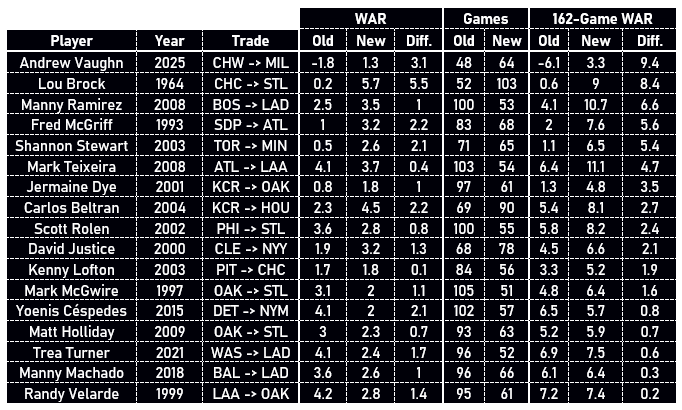
I am aware that articles like the ones I pulled from tend to show selection bias towards both modern players and players with strong careers, such as hall of famers or all-stars. Despite this, while Andrew Vaughn isn't reaching the extrapolated WAR splits of players potentially worthy of Cooperstown like Manny Ramirez and Mark Teixeira, he stands alone in this list in a couple metrics. He is the only player in the entire table to have a negative WAR split, and only Hall of Famer Lou Brock earned more WAR than Vaughn between his two teams in the season he was traded. Despite this, when Brock's WAR splits are extrapolated, he still doesn't reach the whiplash-causing swing Vaughn was able to achieve last year. Notably, Vaughn also has the lowest total amount of games played due to his extended stints in AAA with both the White Sox and the Brewers, which makes his WAR totals lower than others on the list and extrapolation a valuable tool to project how he would have fared as an offseason acquisition.
Andrew Vaughn's story in MLB is still being written but stays enticing -- a promising prospect that found himself placed on a sinking ship and, in his confusion, pailed water from the ocean into the boat. After being tossed aside to the Charlotte Knights and reclaimed by the magicians on the Brewers, he has turned his career around with a mid-season turnaround not seen in MLB history. Teams don't typically take fliers on players like the White Sox' version of Vaughn, nor do they keep players around long enough to see them dig into 1891 Gus Weyhing levels of woe. Vaughn's tale is a mixture of organizational brilliance and ineptitude, fortuitous timing, and reclamation.
During the 2025 season, I would hate-check Vaughn's Brewers stats weekly. Despite my disdain for him as a White Sock, I'll be rooting for him as a Brewer and can hardly wait to see whether the rocket-like trajectory he's on still has fuel.