A Recent History of Carleton College Football
Written 03-01-2026
Introduction
Above all else, college football is a strange sport. At its surface, it seems to be a younger version of the NFL -- packed stadiums with tailgating outside, passionate fans, a similar football product on the field. Peeling back a layer and entrenching oneself in the oddities of college football leads to some bizarre discoveries that make the sport so enticing to self-proclaimed "sickos". The anthropomorphic mascot sacrifice in the Pop Tart Bowl or the "MACtion" that populates the dusk of Tuesday nights just scratches the surface of the esoteric traditions that are integral to college football. There are only 32 NFL teams, but 138 teams in the highest level of college football known as the FBS, meaning that fandom is sometimes more passionate within the smaller region each team encompasses. It's easy to think of examples like fans of the University of Alabama using "roll tide" in place of punctuation or fans of The Ohio State University threatening death upon those who forget the "the" in the name, but even less notorious schools such as the University of Minnesota and Iowa State University have pockets of ardent and dedicated fans.
However, this post isn't about FBS college football. When looking at the ecosystem of college football, you can lift a rock to find one of the purest forms of sport: Division III football. Existing primarily east of the Mississippi River, there are 240 Division III schools that encompass even smaller regions of the map. At these schools, football isn't a weekly spectacle featuring famous athletes largely removed from the student body -- rather, the players are friends, classmates, and dormmates. They're not playing for a national championship or to be a first round draft pick but rather do so for the love of the game and regional trophies that hold immense meaning within the bounds of the college town each school resides in but little outside of it. Division III football is the sport stripped of its frills, which is quite approachable to both a new fan with ties to a team and depraved college football sicko alike.
My Division III school, Carleton College in the tiny town of Northfield, Minnesota, is one with a rich football history, having started play nearly 150 years ago in 1883. Its first game as the Carleton Knights was against the University of Minnesota -- now a member of the famous Big 10 conference in Division I -- and ended how most football games did at this time: with a paltry score of 4-2. Throughout the 20th century, Carleton's football program persisted and won multiple conference championships and produced successful student athletes in droves. This post is not about Carleton's full history, though. For that, I recommend the book Knights of the Gridiron: A History of Carleton College Football 1883 - 2005 by former coach and the namesake of the field at Laird Stadium that Carleton plays on today, Bob Sullivan. This post is about the recent times, the 21st century. It's about the years that I was able to experience as a student on campus, playing euchre with the center across the hall and grinding away at homework with the tackle in the physics major, that attached me to the Knights as a fan.
Arriving on Campus: 2018-19 Seasons
The 2010s, as a decade, were unkind to Carleton football. In the three years before I became a student in 2018, Carleton posted a 3-28 record and were outscored 16.41-42.22 on average. The general attitude towards football on campus was that it was secondary, if that, to the school's main sport, ultimate frisbee, who had just won a Division I national championship the year prior. I was loosely invested in football by virtue of two players being a part of my tight-knit freshman year floor but didn't go to the field to actually watch Carleton football in action -- instead, everything I had heard was either by word of mouth or via combing through statistics online after games. It was through this word of mouth that I learned about interesting tidbits of Carleton's football history, such as Laird Stadium being one of the largest in Division III and originally being built with Carleton's membership within the Big 10 in mind, the trophies that Carleton plays for, or the fact that Carleton hadn't won a game versus cross-town rival St. Olaf since 2013. Ahead of my freshman year, Carleton changed head coaches to their current leader, Tom Journell, who immediately declared that he would win the MIAC, the conference Carleton plays in. While Carleton didn't win the MIAC, Coach Journell did lead Carleton to match its win total over the past three years with a 3-7 record. The same word of mouth I had learned about the history of the program from began to whisper that Carleton football was on an upswing.
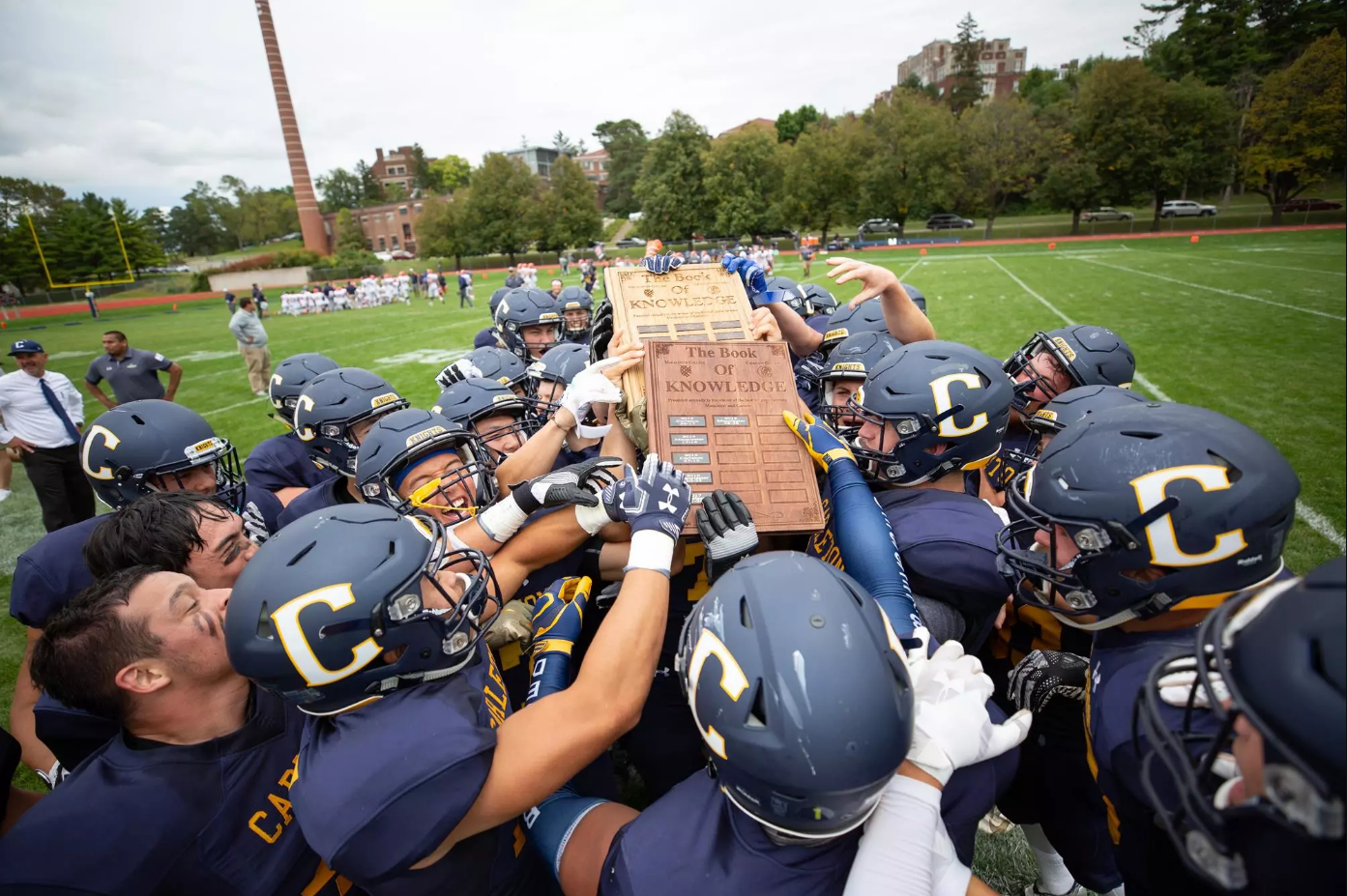 Carleton football lifting The Book of Knowledge in 2019. Photo by Nathan Klok.
In 2019, Carleton improved upon its record to 4-6 with a statement 41-0 win in the first game of the season over longtime rival Macalester College, Carleton's first shutout since 2011. Macalester and Carleton, despite being in different conferences until 2021, play once per year for "The Book of Knowledge", a plaque commemorating their games dating back to 1983 including last year's 38-48 Macalester win. A regional trophy, for the first time in the current seniors' collegiate career, lived within Carleton's campus. I remember the campus that Saturday night after the game buzzed more than usual with parties and revelry, and the trophy was being passed around -- a sign that Carleton football was getting its footing back as a program. The demons within the MIAC that had previously haunted Carleton were looking less scary than before: in 2018, Carleton lost to nationally ranked Saint John's University, University of Saint Thomas, and Bethel University by a combined score of 0-175, whereas in 2019 they put points on the board and held each team to less points than the previous year to a combined score of 38-161. While Carleton's defense mostly remained at the level it was the year prior, the program's offense took a leap forward: their offensive yards per game rocketed from 270.60 to 344.10 allowing them to hang around in games. Coach Journell was creating a positive feedback loop within the team -- as he describes it, "the more success, the more the fun, the harder people worked, the more success." Despite Carleton's 2-0 start fading away to a 4-6 record, morale was high as Carleton had posted its best football season since 2013. I was excited to see how the team would fare in 2020.
The Pandemic: A Reset for the 2021 Season
It would turn out, however, that nobody fared particularly well in 2020. The COVID pandemic affected nearly the entire world, cancelling the 2020 season. It split my college experience cleanly in half, with a clear "before" and "after" COVID hit campus during my sophomore year. However, bringing in two classes of recruits and taking the season off happened to be a blessing in disguise for the Knights' football program. Carleton's remoteness, rapid response to the pandemic, and student diligence helped turn the campus into a spot of relative normalcy quicker than most of America, and by the early months of 2021 mask mandates began to lift and social circles began to expand as the number of positive COVID cases dwindled. The pandemic didn't halt the Knights' momentum that Coach Journell had gathered over the past two years -- rather, he was able to seize the moment and pivot. When asked about how the pandemic affected the team, Coach Journell said that:
The reflected, modified, and refined engine that powered the Knights revved into form in 2021, storming to their first 4-0 start since 2008 while forcing 11 turnovers and outscoring their opponents, including Macalester, by a combined score of 160-30. Quarterback Johnathan "Johnny" Singleton had some ridiculous games within this stretch, including a 30/40 365-yard clinic versus University of Minnesota Morris and a six-touchdown bomb against Crown College, tying a school record. There was a longing for connection and a revival of campus culture due to the disruption COVID caused, and the football Knights' incredible start provided a timely and popular vessel for students to get behind. Tailgates prior to games at Laird Stadium swelled to sizes I hadn't seen in pre-COVID years on campus and there was an excited air about the eastern side of Northfield. The Knights' start to the 2021 season, coupled with Carleton frisbee's relative decline in 2019, had student fans more aligned with football than frisbee on a campus that quite literally gives a frisbee to every new student. At this point, I started going to games in person and witnessed what felt like a renaissance on grass.
In the fifth game of the season, the Knights were matched versus their cross-town rival, Saint Olaf College, who had bested Carleton in their past six contests. The crowd of students that headed over the river to St. Olaf numbered in the hundreds, a significant percentage of Carleton's enrollment of 2,000, chanting and blasting a trap version of Carleton's alma mater made by fellow Class of 2022 student Leander Cohen from multiple speakers. Being in this crowd felt dream-like, as I was immersed in something I had only witnessed on broadcasts of College GameDay: coalesced college football fandom. Unfortunately for Carleton, their red-hot start ended at Klein Field as St. Olaf jumped out to a 0-23 lead at the half and maintained it to a 14-23 victory. The nerves seemed to hit the squad, with starting center Matthew Rasmussen recounting that the offensive line "played tight and rigid when we spend most practices laughing our asses off". My freshman year, St. Olaf felt untouchable and the Goat Trophy that St. Olaf and Carleton fought for annually may as well had been a myth. My senior year, even though Carleton didn't win the game versus St. Olaf, the Oles felt fallible and Carleton was stronger than ever with a 4-1 record to show for it. The day that Carleton would break their losing spell against St. Olaf felt close, and even though my Class of 2022 never saw a Carleton win, we knew that it was imminent.
The next week, a 30-14 smack over the head to new MIAC member College of Saint Scholastica vaulted Carleton to a 5-1 record. This game saw Carleton defensive end Michael Carey notch 3.5 sacks, a forced fumble and recovery, and a pass breakup in a stellar defensive performance. However, ahead lied Carleton's toughest opponent yet: Concordia College, a team that sported an 11-game win streak versus Carleton dating back to the 2008 season.
The Miracle: October 23rd, 2021
Carleton's history against Concordia College, up to this point, is grim: out of 22 games since 1998, Concordia won 21 of them: a 0-35 shutout in 2001 followed by a 7-51 offensive explosion in 2002, a tight 24-27 win in 2015, and all manner of margin of victory in between. Concordia appeared to be a kryptonite for Carleton -- but, with home field advantage, the homecoming buff, and the strongest team the Knights have had in years, it felt like Carleton had a real chance to walk away with the win. Concordia scored first with a 43-yard run by quarterback Tanner DuBois and managed to expand their lead to 7-21 with a passing and running touchdown headed into the half. Despite the score difference, the time of possession was even and there were no turnovers yet: the Knights just had trouble converting any drive past their first into points. The second half opened up with eight consecutive punts before DuBois threw the only interception of the day into the waiting arms of Carleton's Henry Detmer early in the fourth quarter. However, just a few plays later, Concordia's Mitche Sullivan sacked Singleton and forced a fumble which was recovered by Concordia, taking the wind out of the fans' sails.
However, as Coach Journell wrote to me when asked about the game, the Knights "kept swinging and didn't quit". A crucial fourth-down sack by Carleton's John Witte made Concordia turn the ball over on downs, and less than a minute of in-game time later Singleton dropped a 49-yard bomb to wide receiver / gadget quarterback Beau Nelson to bring it within a touchdown. With 9:13 in the fourth quarter, Concordia aimed to burn as much of the clock as possible while putting the game out of reach for Carleton via repeated rushes by Ben Hoggarth to the tune of 58 rushing yards and four first downs that culminated in a fourth-and-one at the Carleton 9-yard line. DuBois tried to punch it through but was stopped short of the line to gain, leaving Singleton with 2:42 on the clock to drive 91 yards. Then, by account of then-first-year wide receiver Garrett Siff, Singleton "entered a different dimension" and strung together a series of quick gains. Johnny's rushing ability shone through in this drive: a 17-yard dash alongside short- and medium-range passes pushed Carleton to the 25-yard line.
However, with 39 seconds left in the game, disaster struck: a 12-yard sack shoved the Knights to the 37-yard line, and the next play a short pass to wide receiver Nathan Streiff was fumbled but thankfully recovered by running back Aiden Chang. A short pass and spike was offset by a delay of game penalty to leave Carleton staring down a 4th and 20 with 6 seconds left on the clock. Concordia was starting to dance and celebrate on the sideline as offensive coordinator Bob Davies schemed. There was time for Singleton to make exactly one play, and that he did: a 35-yard bomb to Garrett Siff for the hail mary touchdown. Carleton lined up to go for a two-point conversion but couldn't get set -- after the second delay of game penalty in as many plays, kicker Trent Ramirez tied the game at 21 and sent Carleton to overtime. The crowd was electric, but the comeback wasn't complete yet.
I had never seen a football game make it to overtime before and quickly familiarized myself with the rules: each team gets a drive from the 25-yard line per overtime period, and if the game is tied after two periods they trade two-point conversions until a winner is crowned. The most famous example of this is a University of Illinois vs. Penn State University nine-overtime gauntlet that, funnily enough, also happened on October 23rd, 2021. Concordia started with the ball and traded carries between DuBois and Hoggarth for a quick six points -- however, they elected to go for a two-point conversion which was intercepted in the end zone, meaning that Carleton only had to score a touchdown and punt an extra point through to secure the victory. According to offensive linemen Logan Plasch and Connor Kelly, the defensive line of Concordia tensed up, as there was almost an inevitability the momentum gained in the fourth would lead to a Knights score. And, for the final time, Singleton drove the ball down the field: aided on the drive by an illegal use of hands penalty by Concordia, Johnny dotted a short touchdown to Nelson thanks to a tricky motion by Siff. This set the stage for Trent Ramirez to blast the kick through the uprights to complete the comeback: 28-27, Carleton.
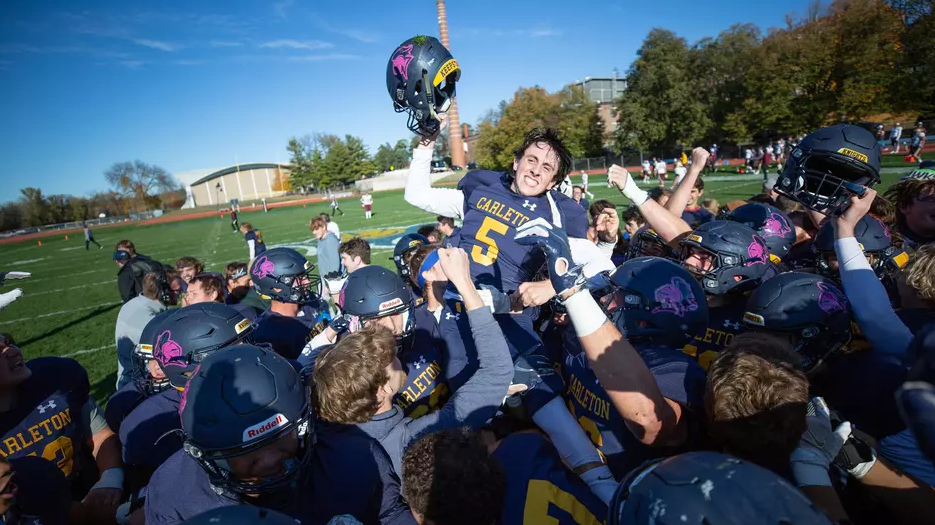 Trent Ramirez being lifted by the Knights after his game-sealing kick in 2021. Photo by Nathan Klok.
The aftermath of the MIAC Miracle, as it was dubbed, was immense for the program. Around a hundred people stormed the field, and the campus was rowdy with celebration -- the bass from Leander Cohen's Alma Mater rattled the foundation of senior housing that night. The phrase "MIAC Miracle" was repeated by students who didn't even watch football in any capacity, professional or collegiate. Statistically, it secured Carleton's first winning season since 2008 by boosting their record to 6-1. Trent Ramirez was named the MIAC Special Teams Player of the Week -- a tough ask in a conference with nationally ranked teams -- and his triumphant photo spread like wildfire amongst college football circles. Coach Journell, a self-proclaimed "D3 guy" and football lover, was able to revel in the moment and when asked to recount it years later by me, did so in vivid detail:
Siff, an unlikely hero that had only been on campus for a few months at that point and played only three snaps the entire game, was also able to remember the hail mary well:
The magnitude of the moment collectively imprinted a classic memory on hundreds of Carleton students, staff, and alumni. In the small section of Minnesota that Carleton inhabits, this was our Kick Six, our Jadeveon Clowney hit, our Statue of Liberty play in the Fiesta Bowl.
The 2021 season would ultimately end with the hardest part of Carleton's schedule resulting in two losses to Gustavus Aldophus College and St. John's before defending the Book of Knowledge against Macalester during a snow game in the MIAC playoffs. Said game was the last of my time as a student fan, alongside center Matthew Rasmussen's career, who was able to "enter the flow state" as they ran over Macalester for 180 yards towards a tight 48-45 victory.
The Knights' resurgence was undeniable -- I had watched a team that went 0-10 prior to my freshman year improve incrementally to a 7-3 record during my senior year, which was Carleton's single best season since 2008. The 2021 season constituted a great set of games to say goodbye to Carleton football as a student fan with. However, one thing was missing: a victory against St. Olaf.
Graduation: 2022-24 Seasons
Northfield is a town of 20,000 people. One quarter of them are college students, with around 3,000 at St. Olaf and 2,000 at Carleton. The rivalry across the river is as fierce as it gets, with the fight versus St. Olaf for the Goat Trophy being waged near-annually since 1931. Most of the players I interviewed for this post said that this game was the most important on the calendar with strong opinions such as that from fullback/tight end Ben Zhao saying that "the pure animosity between the two teams is unmatched" to Coach Journell comparing the rivalry to the infamous brawls in FBS -- Ohio State vs. Michigan, Army vs. Navy, Alabama vs. Auburn -- while stating it is unlike any other game he's had the privilege to coach. This game was personal, which made every loss for the past seven years sting whether it was an Ole blowout or a scrappy fight.
The Knights got off to another fiery start in 2022, once again reaching a 4-0 record that included an 84-20 beatdown of Crown College which saw the Knights score their second-highest point total in program history. Once again, Carleton was versus St. Olaf with a 4-0 record in tow, but the atmosphere was different: Carleton had home field advantage and the offense hadn't scored below 41 points all season. Having already graduated, I wasn't able to watch the game in person like I had last year, but I can only imagine that the air was different as Carleton punched first when Singleton found second-year receiver / tight end Ntense Obono in the endzone in the first quarter. The Oles managed to tie it up 7-7 in the second quarter, but Carleton managed to pull ahead 13-7 thanks to a pair of field goals by Ramirez. In the 20 minutes and 44 seconds of game time between Trent's second field goal and the end of the game, Carleton had possession for over 75% of it: 15 minutes and 51 seconds. In this 20-minute stretch, St. Olaf quarterback Theo Doran completed three of his ten passes for 52 yards. Unfortunately for Doran, two of those passes were back-to-back fourth quarter interceptions to Carleton's Ryan Flanagan and Isaac Simons on athletic catches that resulted in ample opportunity for the seniors, Johnny Singleton and Aiden Chang, to add to their gargantuan rushing totals on the day and grind out the clock. When the dust settled, Carleton was ahead 26-7 and, for the first time in nearly a decade, beat St. Olaf.
Theo Doran was swarmed by the Knights' defensive front all game, putting up a tour date with his passing numbers (11/30) for a completion percentage of 36.67% on top of 178 yards -- his worst mark of the year. He performed better against St. Johns (13/28, 235 yds., 2 INT, 1 TD) and Bethel (19/32, 195 yds., 1 TD), ranked #5 and #11 at the time they played, respectively. Carleton's offense won in the trenches, with Singleton rushing for a career-high 132 yards and Chang not too far behind at 118. This was the first time Carleton had two hundred-yard rushers since 2014 as they outrushed St. Olaf 295 yards to 64, more than doubling Olaf's per-play production (4.76 yards per carry versus 2.37). Singleton also broke Carleton's career passing yards record this game, bringing his total to 5,561 up to that point. Carleton's special teams ensured that the Knights would win all three phases of the game, with Ramirez nailing both field goals and both PATs alongside converting what was eventually an onside kick via a muffed catch by the Oles. In the words of Ben Zhao, "just physically dominating that school was just the best", and this domination led to a ten-year weight being lifted off the team's shoulders.
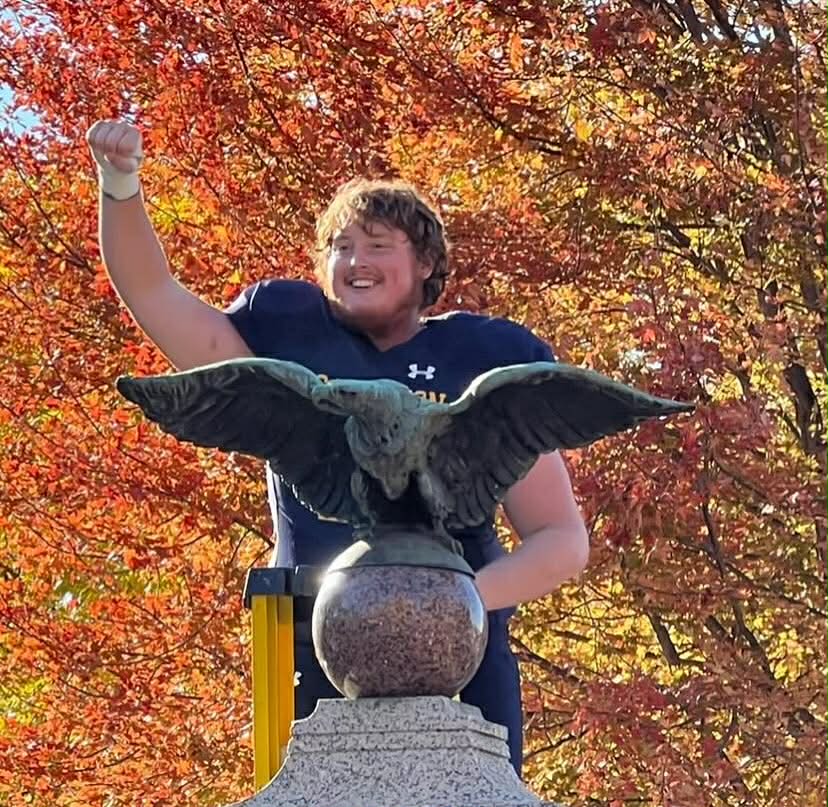 Senior offensive lineman Connor Kelly posing with the eagle at Bridge Square Monument, facing east towards Carleton for the first time since 2014.
Carleton students, of course, stormed the field in what was the program's most meaningful win in years. In a tradition that I was never able to witness, Carleton's football team marched towards the Bridge Square Monument at one of Northfield's busiest intersections and turned the eagle on top of the memorial to face the winning campus. Having only graduated a few months prior, my social media was still filled with pictures of Carleton students scaling the monument and posing. It was a moment of jubilation for Carleton's football team, particularly the seniors that endured consecutive losses up to this point, and I can only imagine the campus' energy level that Saturday night. Through smart recruiting and savvy coaching by Journell and his staff, Carleton was officially out of the rubble and breaking curses that had plagued the program for years. The 2022 season would eventually end with Carleton notching another 7-3 record, with a tight 13-20 overtime loss to Concordia avenged in the MIAC playoffs a few weeks later with an even-closer 17-14 win. In Carleton football's history up to this point, only twice had they won 14 games in two years -- 1988-89 and 1992-93. The 2021-22 span would be the third.
The fourth would come sooner than expected as the Knights matched their win total from the previous two years in another 7-3 campaign. The 21 wins that Carleton garnered within the previous three years are the most in a three-year span since at least 1930. College football is inherently transient as students graduate and are only eligible to play for a few years at a time, but the culture Coach Journell was able to cultivate persisted. The players that I'd become familiar with like Johnny Singleton, Trent Ramirez, and Aiden Chang had graduated, making way for the next generation of players to don the maize and blue. The 2023 season featured a nail-biter against St. Olaf in front of a packed house with nearly double the attendance of the previous two years, as it was both schools' homecomings. Garrett Siff, who played on a broken foot and partially torn hamstring in different legs, describes the game as the most memorable rivalry game he'd ever played as it was the only time he'd ever seen Laird Stadium at capacity and it was "the peak of tensions between the two football programs" due to off-field events. He caught 8 passes for 47 yards from new starting quarterback Jack Curtis, who threw 3 touchdowns and bested St. Olaf, 33-31, to keep the Goat Trophy at Carleton. Curtis told me that the Olaf games "just mean more" -- now that the rivalry was competitive, a fire was suddenly lit below both teams: Carleton to keep their momentum, and St. Olaf to get the goat back.
In 2024, Carleton would post their fourth consecutive season finishing at or above .500, finishing with a respectable 5-5 record. Unfortunately, Carleton's hold of the Goat Trophy was lost in a close 13-19 battle that saw St. Olaf jump out to an early lead and stave off a Carleton comeback, similar to the 2021 showdown. Carleton also snapped a 26-game loss streak dating back to 1997 versus Gustavus Adolphus College thanks to a monstrous passing performance: 28/39 for 469 yards and a school-record 7 touchdowns by Jack Curtis, with 282 of those yards and 4 of those touchdowns going to junior wide receiver Tyler Dimond for the second-highest total in both marks in all of Division III that year. This year was the last hurrah for the Class of 2024, who had 26 wins in their collegiate careers, the most in a four-year span in the entire history of the program besides the Class of 1989, who had 27. Jack Curtis, now a junior, put up his second season of over 2,000 passing yards -- making him and Johnny Singleton the only Carleton quarterbacks to have done so since 1990. Dimond averaged close to 100 yards a game off the back of his explosion versus Gustavus, while senior defensive back Henry Detmer ranked 4th in the MIAC with 83 total tackles. Despite Carleton having their worst record since 2019, the program was still strong and poised to leap forward in the 2025 season.
Inspiration: The 2025 Season
The 2025 season is one of the most inspirational in program history, and certainly the recent history I researched for this post, in large part due to Jack Curtis' senior season. He posted career highs in nearly every statistical category -- 3,120 yards, 284/392 passing for a completion percentage of 72.44, and a 29-7 TD to INT ratio, the first two being Carleton records. These only added to his lofty career totals which nearly eclipsed every quarterback record set by Johnny Singleton and the architect of Carleton's successful 2008 season, Shane Henfling, including those for completions, yards, passing touchdowns, and completion percentage. The main story this season, however, was that Jack was putting up the best numbers in Carleton football's 142-year history while battling cancer, diagnosed as an "unfavorable" late stage 2 Hodgkin's Lymphoma.
Jack went from being unable to practice due to mid-week chemotherapy to galvanizing his teammates on Saturdays en route to some of the best games of his career. A 25/34, 478 yard, 6 touchdown bombing of Macalester to keep the Book of Knowledge, 51-7, and a 29/39, 401 yard, 6 touchdown rout of Hamline University, 63-14, were the most statistically impressive. However, the most meaningful was a 29/42, 396 yard, 3 touchdown fight against St. Olaf that ended in a 35-28 victory and the Goat Trophy going back to Carleton for the third time in four years. When I asked about his most memorable moment as a Knight, it was this game:
Between showing out on Saturdays, chemotherapy treatments, and enrolling in the most difficult physics class I have ever taken -- Advanced Classical Mechanics with Dr. Jay Tasson -- Jack's 2025 fall trimester is amongst the most impressive terms I have seen someone complete at Carleton. Couple all of this with an injury to his throwing hand sustained during the ninth game of the season versus Bethel, which Jack managed to come back from to throw 3 touchdowns on 37/56 passing in a close loss to Concordia for the season finale, and it makes for a showing that truly embodies the spirit of Division III football. A mantra of Carleton's football team is creating "scholars who are ballers," and Jack's season embodied it to a T. His incredible season resulted in a trove of accolades: MIAC Offensive Player of the Year, a D3football.com All-Region Third Team nod, and being one of five finalists for the Gagliardi Trophy, Division III's most prestigious honor which recognizes the most outstanding player in the division.
In addition to Curtis' MIAC OPOY award, nine other Carleton players earned honors including all-region first team offensive lineman senior Declan Schwab, who didn't allow a sack all season despite facing three nationally ranked defenses, senior tight end Rye Storrs, who led the team in receiving, and senior kicker Marcus Merkelbach who managed to eclipse nearly all of the school's kicking records, both single-season and career. In the D3Football.com article linked above, Jack proclaimed that "to come back for my senior year with my best friends to play this game one last time is a blessing and I am not going to let cancer define who I am." He was able to elevate and inspire Carleton's players, particularly the senior class, to an unforgettable season in the program's expansive history. The 2025 season ended with a 6-4 record, marking the third time since 1930 that the team had a streak of five seasons at or above .500 (1954-58, 1985-90), but this a footnote in the most recent installment of Carleton football's turnaround from relative mediocrity to force in the MIAC. I'd like to think that the 2025 season ended with an unofficial 7-4 record, with the final win coming on December 19th, where Jack rang a bell at the Mayo Clinic while surrounded by his teammates, signifying the end of his treatment. In an Instagram post commemorating the achievement, he captioned it "Called Game. Knights 10 Cancer 0" -- a follow-through on the proclamation he made about not letting cancer define him, having started all ten games that year.
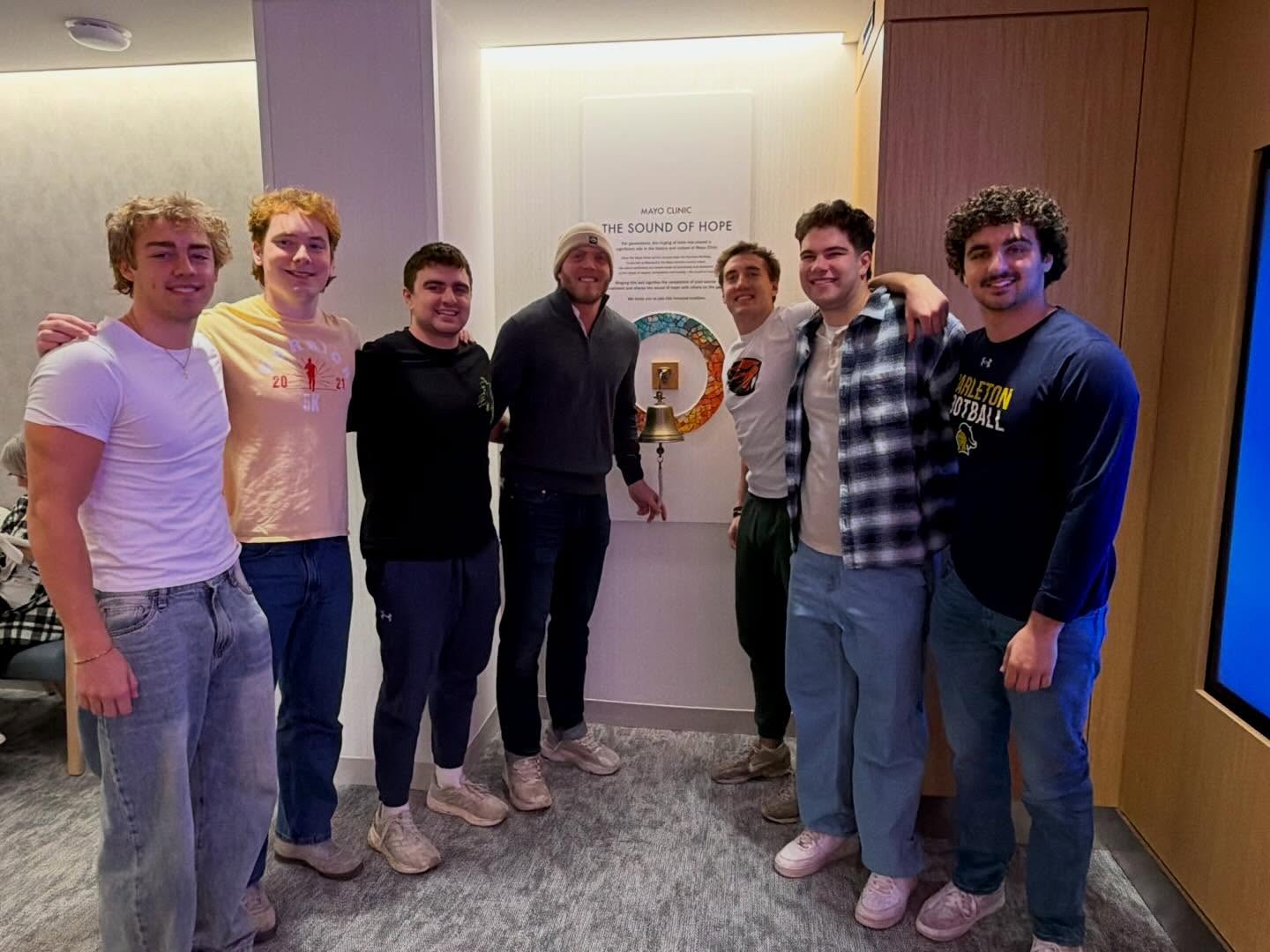 Jack Curtis, surrounded by his teammates, as he rings the bell at the Mayo Clinic.
Conclusion
I was blessed to have the opportunity to ask a few questions to several Carleton football players for this post. I switched up the questions based on age and position, but kept one constant: "with hindsight, if you had an equivalent financial offer from a FBS school, would you take it?" Perhaps predictably, every single player said no. Every single player cited the traditions and community as reasons why they wouldn't -- the community focus on both academics and athletics alongside the storied traditions of college football, such as the turning of the eagle, constitutes a singular experience in sports. Coach Journell has had experience within Division I as a graduate assistant at Miami University, but has a drive to continue coaching Division III as a desire to be a part of the community:
The most memorable moments for Coach Journell, more than the MIAC Miracle or the victories over St. Olaf, are graduations and reunions where he can see how his former players are doing in a post-collegiate world. He was recruited here by his own son, Mack Journell, who graduated in 2020, further highlighting the strength of community that makes Division III so unique. Coach Journell's point about Division III football being "one of the last purest forms of amateurism" resonates with me, as the concentration of true ‘football guys' within Division III circles is unlike anywhere I have ever seen. Carleton football's motto is "Keep Stackin'," a battle cry visible on helmets and across promotional material that encourages stacking successes across all facets of life, whether it's weights on the rack or academic achievements. Coach Journell explains the philosophy of the motto as "attitude and investment, approaching every day with a positive attitude, and then hard work." Over its recent history, Carleton football has continued to stack wins on the field, enticing stories off it, and memorable seasons to Carleton students that engage with the team and the community it helps foster.
Every Division III school has rivalries, regional trophies they fight for, and rituals they engage in -- Carleton just happens to be the one I unknowingly chose to steep myself in, and I've become far richer by doing so.
I'd like to thank Coach Journell, Jack Curtis, Garrett Siff, Matthew Rasmussen, Connor Kelly, Logan Plasch, and Ben Zhao for taking some of their time to answer my questions and guide writing what has been a pleasant dive into the history of the program. All stats come from either Carleton's website, NCAA's website, or College Football Results.